
PISA 2025: What the New Results Tell Us – and What They Cannot
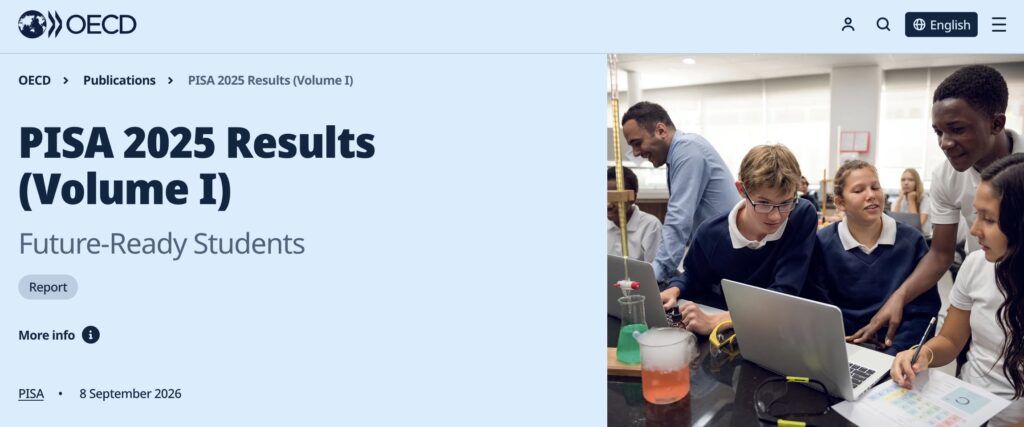
The latest results from the OECD’s Programme for International Student Assessment, PISA, have arrived to the predictable mixture of alarm, reassurance and political interpretation. Reading and mathematics performance have fallen sharply across the OECD over the past decade, while science has proved more resilient. At the same time, the report offers one of the first large-scale international glimpses of how artificial intelligence and digital tools are entering students’ learning.
The results deserve attention. But they also deserve careful reading. PISA is influential precisely because it reduces complex education systems to a set of apparently comparable numbers. Those numbers can help us see patterns, but they cannot by themselves explain why those patterns exist or tell us what a country should do next.
What is PISA?
PISA is the OECD’s Programme for International Student Assessment, launched in 2000. It surveys students around the age of 15 in participating countries and economies. Rather than testing only whether students can reproduce material taught in school, PISA aims to assess how well they can apply knowledge, reason, communicate and solve problems in situations that resemble real life [1].
The choice of age is intended to provide a common point of comparison near the end of compulsory schooling. Students may be in academic or vocational programmes, in public or private schools, and following very different national curricula. PISA therefore does not measure whether students have mastered a particular country’s syllabus. It measures performance against common assessment frameworks designed by the OECD and its partners.
PISA 2025 was the largest cycle so far. More than 760,000 students, representing approximately 33 million 15-year-olds, took part across 91 countries and economies. Science was the principal domain, alongside reading and mathematics. The cycle also introduced an assessment of Learning in the Digital World, focused on computational problem solving and students’ ability to use digital tools in an iterative and self-regulated way. An optional assessment of English as a foreign language was also offered [1].
The broad picture is troubling
The headline is not a sudden collapse between 2022 and 2025 in every subject. It is a longer decline, intensified by the disruption of the pandemic but in many systems beginning earlier. Across OECD countries, average reading scores fell by 28 points between 2015 and 2025, while mathematics scores fell by 22 points. The OECD describes these changes as equivalent to roughly one and a half years of learning in reading and just over one year in mathematics [2].
Science looks less dramatic. Average OECD science performance fell modestly between 2015 and 2025 and was broadly stable between 2022 and 2025. Even so, the overall picture is worrying: one in five 15-year-olds across the OECD is now a low performer in science, mathematics and reading, compared with 16 per cent in 2022 [1].
The results also show that inequality remains central. Students from advantaged backgrounds scored 85 points higher in science than disadvantaged students across OECD countries. The gap narrowed slightly between 2022 and 2025, but largely because advantaged students performed less well, rather than because disadvantaged students made substantial gains [2]. A fall in inequality produced by decline at the top is hardly an achievement to celebrate.
There are exceptions to the general pattern. Several systems improved in science, and the highest-performing group across all three core domains included most participating Chinese jurisdictions, Estonia, Japan, Korea, Singapore, Chinese Taipei and the United Kingdom. These comparisons may be politically useful, but they should not be mistaken for simple lessons waiting to be copied. Education systems are embedded in different histories, labour markets, cultures and welfare arrangements.
What the report says about AI and technology
The OECD’s message on technology is more cautious than the promotional language often surrounding educational AI. Digital tools can be useful, but their relationship with performance depends on how they are used. Moderate use of digital devices for learning was associated with stronger science performance, while excessive use and digital distraction were associated with weaker outcomes. More than one in four students reported that classmates were distracted by digital devices in most or every science lesson [2].
The findings on AI are especially interesting, although they need to be interpreted as associations rather than causal effects. Across the OECD, 46 per cent of students reported using AI chatbots weekly or more to learn. Students who said they did not use AI chatbots to draft writing assignments generally performed better than students who said that they did. That does not prove that using AI caused poorer performance. Students who use chatbots may differ in motivation, prior attainment, access to support, the type of task they are doing or the way they use the tool.
The more encouraging finding is that frequent users who used AI to help them learn and had been taught how to assess the quality of AI-generated information tended to perform better than frequent users who had received no such guidance [2]. This is consistent with a distinction that is becoming increasingly important: using AI as a substitute for thinking is not the same as using it as a support for learning.
The new Learning in the Digital World assessment reinforces that point. Nearly two-thirds of students across OECD countries reached the relevant proficiency level in computational problem solving. But only about half reached that level while also demonstrating basic proficiency in science, reading and mathematics [2]. Digital competence cannot compensate for weak foundations. Students need both the ability to use computational tools and the underlying knowledge required to judge, interpret and apply what those tools produce.
The report’s practical conclusion is therefore restrained. AI should be used for clearly defined purposes and in moderation. It may support feedback and personalised practice, but it should add to students’ effortful learning rather than replace it. The central educational resource remains the learner’s own attention, effort and understanding [2].
The methodological cautions
PISA is a large and technically sophisticated survey, not a casual opinion poll. The OECD publishes technical standards, databases and manuals that allow researchers to inspect and reproduce its analyses [3]. It would be wrong to dismiss the results simply because they are imperfect.
But PISA is also frequently asked to carry more weight than its design can support. First, it is a cross-sectional survey of 15-year-olds, not a longitudinal study tracking individual learning over time. It can identify relationships between performance and reported circumstances, but it cannot normally establish that one factor caused another. This matters particularly for claims about screens, AI or teaching practices.
Second, PISA is a population-level assessment, not a precise league table of national education quality. Countries are separated by estimates with uncertainty intervals, and apparently small differences may not be statistically meaningful. Yet public debate routinely turns these results into rankings and political scores. The ranking format encourages the belief that a country is simply “better” or “worse”, when the underlying differences may be modest and the systems may be succeeding in different ways.
Third, the test measures selected forms of knowledge and competence. Its frameworks are substantial, but no international assessment can capture the full purposes of education: civic participation, ethical development, creativity, vocational identity, relationships, cultural knowledge, wellbeing or the capacity to live meaningfully with others. Yong Zhao has argued that PISA’s claim to measure the skills essential for future life rests on an insufficiently demonstrated and potentially Western-centred conception of what those skills are [4]. That criticism does not make the data useless. It does mean that the assessment framework should not be confused with a complete definition of educational success.
Fourth, some of the contextual evidence comes from questionnaires completed by students, school leaders and others. These data are valuable, but responses can be affected by cultural norms, interpretation of questions and willingness to report particular behaviours. The OECD itself warns that differences between countries in questionnaire indicators should be interpreted with caution [5].
Finally, sampling and exclusion decisions matter. In Spain, for example, the OECD reports an overall exclusion rate of 7.9 per cent in 2025, with particularly high within-school exclusions in Catalonia and Murcia. It warns that high exclusion levels can produce upward bias, and Catalonia’s results are not reported separately [5]. This is not a reason to disregard the Spanish results, but it is a reason to avoid treating them as perfectly transparent measures of the whole student population.
How have people reacted?
The OECD has framed the results as an urgent call for greater focus, depth, teacher investment, parental engagement and targeted support for disadvantaged students and schools. Its message on technology is that AI can strengthen learning, but only when it is purposeful and does not substitute for attention, effort or understanding [2].
Education International has interpreted the findings through a different lens. Its response links falling outcomes to teacher shortages, shrinking attention, digital distraction and chronic underinvestment. Its general secretary, David Edwards, argues that AI is being presented as a “magic solution” when what students need is a stronger social core to education and a properly supported teacher workforce [6].
National reactions have tended to follow familiar political lines. In Northern Ireland, the education minister described the findings as a “wake-up call”, while the teachers’ union NAHT highlighted persistent inequalities, funding pressure and the growing demands placed on schools [7]. In France, the results were reported as the country’s lowest scores since the beginning of PISA in reading and mathematics, intensifying an already established debate about educational decline [8].
These reactions are not necessarily contradictory. One emphasises system improvement and better use of evidence; another points to staffing, public funding and the social conditions of learning. The danger is that PISA becomes a vehicle for whichever reform agenda a commentator already favours. Declining scores may be used to justify more testing, more technology, curriculum reform, teacher accountability or greater investment in public education. The numbers do not decide between those options by themselves.
What should we conclude?
The most defensible conclusion is neither that PISA has proved education is failing nor that it has revealed a simple programme for recovery. It has documented a substantial decline in measured reading and mathematics performance, continuing inequality and major differences between systems. It has also provided evidence against simplistic claims that more educational technology automatically produces better learning.
On AI, the report offers a modest but important lesson. The relevant question is not whether students use AI, but what they use it for, what they understand about its limitations and whether it strengthens or displaces their own thinking. Guidance matters. Digital access matters. Strong foundations in reading, mathematics and science matter even more.
PISA should therefore be treated as one source of evidence in a larger conversation, not as the definition of educational quality. It can help identify patterns that deserve investigation. It cannot tell us, without further research and democratic judgement, what education should ultimately be for. Nor can it tell us whether the answer to declining performance is another platform, another test or another commercial AI product.
The report’s most important message may be the least fashionable one: in a period of technological change, education still depends on attention, knowledge, relationships and the opportunity to think. Technology can support those conditions. It cannot replace them.
References
[1] OECD. (2026, September 8). PISA 2025 results (Volume I): Future-ready students. https://www.oecd.org/en/publications/2026/09/pisa-2025-results-volume-i_5265bfb1/full-report.html
[2] OECD. (2026, September 8). PISA 2025: Students’ reading and mathematics performance declined sharply across the OECD. https://www.oecd.org/en/about/news/press-releases/2026/09/pisa-2025-students-reading-and-mathematics-performance-declined-sharply-across-the-oecd.html
[3] OECD. (n.d.). PISA data and methodology. Retrieved September 9, 2026, from https://www.oecd.org/en/about/programmes/pisa/pisa-data.html
[4] Zhao, Y. (2019, December 12). The PISA illusion. National Education Policy Center. https://nepc.colorado.edu/blog/pisa-illusion
[5] OECD. (2026, September 8). PISA 2025 results (Volume I): Spain. https://www.oecd.org/en/publications/pisa-2025-results-volume-i-country-notes_2d4ff9ea-en/spain_748275c0-en.html
[6] Education International. (2026, September 8). New PISA report reveals decline in student performance amid chronic teacher shortage and shrinking attention spans. https://www.ei-ie.org/en/item/32952:new-pisa-report-reveals-decline-in-student-performance-amid-chronic-teacher-shortage-and-shrinking-attention-spans
[7] Meredith, R. (2026, September 8). NI pupils’ scores in reading and maths fall over last decade. BBC News. https://www.bbc.com/news/articles/cq5x356wl2no
[8] Le Monde. (2026, September 8). PISA 2025: Unprecedented drop in French students’ performance echoes worldwide decline. https://www.lemonde.fr/en/france/article/2026/09/08/pisa-2025-unprecedented-drop-in-french-students-performance-echoes-worldwide-decline_6757286_7.html