

The Bender Rule: Pushing back against AI hype
If you can think back to the news five […]

Changing the Curriculum for an Uncertain AI Future
Two recent contributions to the discussion of AI and […]
Open Source AI Is Becoming Infrastructure – but Words Matter
I have been arguing for some time that open AI matters. Not because every model should be treated as risk-free, and not because openness magically solves questions of bias, safety, energy use or power. It matters because AI is becoming part of the basic infrastructure through which organisations work, learn and communicate. If that infrastructure is controlled by a small number of companies, accessed only as a rented service and governed through terms that can change without notice, then users have little real agency. That is why a recent interview with Raffi Krikorian, Mozilla’s chief technology officer, caught my attention. […]
Assessment in the Age of AI: Detection Is Not a Pedagogy
Many people in higher education remain understandably confused about how to manage assessment in the time of AI. The problem is not going away. Students are already using generative tools in varied, everyday ways: to interpret rubrics, plan work, structure arguments, obtain feedback before submission, make notes, revise, rehearse presentations and support accessibility. Jisc’s 2025 report also records students using AI for drafting and research support, while some avoid it altogether because they are unsure whether any use will be regarded as cheating (Attwell, S. 2025). This is an important starting point. We are not dealing with a simple division […]
Not So Fast on AI Tutors
There is a lot of money going into AI in education at the moment. Despite a series of research reports questioning the effectiveness of AI-driven systems, and the insistence of international organisations such as UNESCO – and increasingly of national governments – on keeping a human in the loop, the big software companies are still pursuing their dream of AI teachers. OpenAI, Anthropic, Google and others continue to present education as the next great opportunity for large language models. This may be partly because AI adoption in industry has been less straightforward than the early hype suggested. Education, by contrast, […]
AI for Good (for a Change)
it is hard to enthusiastic about AI at the moment and the daily utterances leaders of the big software companies hardly inspire confidence. Remember in days gone by how AI proponents used to enthuse about how AI would extend access to everyone to education. Well a Google press release brings good news. Google DeepMind has shipped shipped SL2T, a sign-language-to-text model, into Gboard and Live Transcribe on the Pixel 1, starting with ASL to English. It works like voice dictation, but instead of speaking, you sign to the phone’s camera and it turns your signing into text in real time, anywhere […]
Congratulations to Thuy Cae
Many of those colleagues involved in the Erasmus+ AI pioneers project may remember the visit by Thuy Cat to Europe in summer 2025. In an all too short visit, Thuy met managers and practitioners from vocational schools in Germany and Italy as well as making a presentation at an AI Pioneers project meeting. This was part of her work for her Fellowship report: AI Integration for Student Engagement for the Australian International Specialised Skills Institute. Thuy’s Fellowship report has recently been published. The report explores how artificial intelligence (AI) can be integrated into vocational education and training (VET) to enhance […]
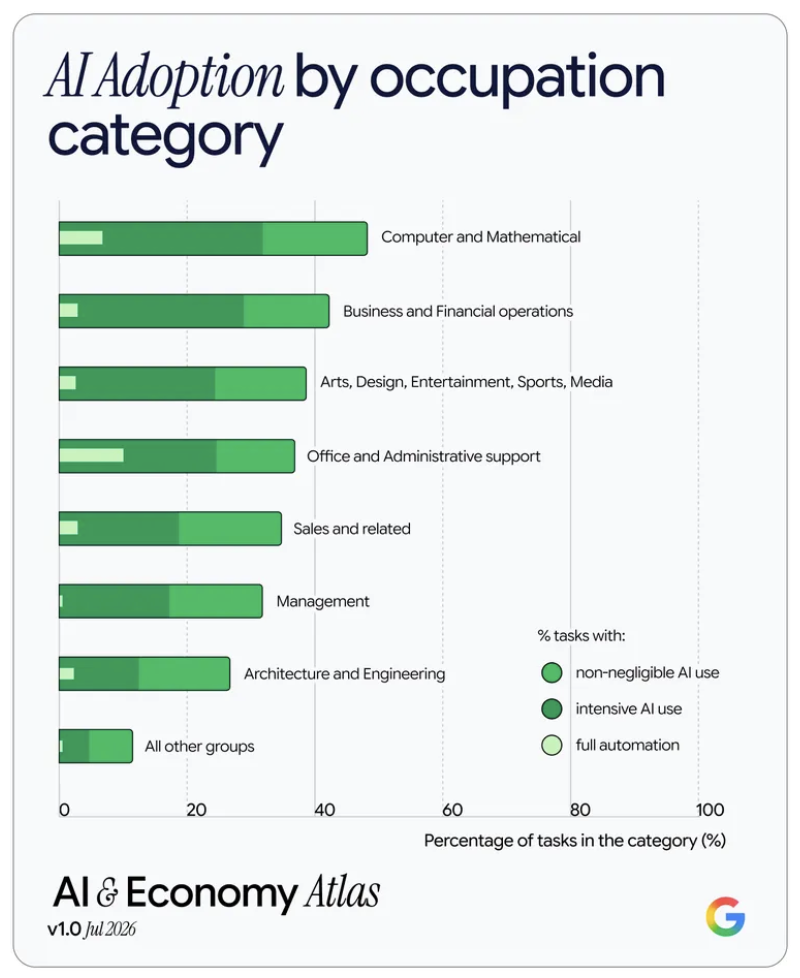
AI Adoption by Occupational Category
Google’s ATLAS, Google say, is an expansive look at […]

Shaping the Future of Education: The EU’s Call for Evidence on AI and Basic Skills
The European Commission has recently announced an ambitious initiative […]

Navigating the AI Hype: A Sceptic’s Look at Practical Uses for Teachers
I admit that I am somewhat sceptical about the […]