
AI: A threat to knowledge and skills
Last week I was talking online with a friend of mine from Germany. Peter is a senior and very experienced computer programmer with whom I have worked for over ten years on projects around careers and education. How is work going I asked him? Are toy getting enough contracts at the moment? The work is booming, he told me. Despite AI and the so called vibe programming I am being offered more work than ever. A lot of the work is sorting out the bugs in AI written software programs. And its not easy work. There’s nothing easy about it – you look at the code and it seems at first to be OK – its well written. You have to spend more time to discover why it doesn’t work and then get it right.
But Peter is not optimistic about the future for programmers. If you are experienced you are going to be OK. But companies aren hiring junior employees any more. Just the opposite, it is junior employees who are being laid off by the big employers who think they can save money by using AI. But it is through getting those first jobs that programmers become experienced, become experts in the field. What is going to happen when the experienced expert programmers retire. Who is going to debug and maintain the AI code then?
And of course it is not just in the computer programming field that this is going on. Data suggests that graduates in many cunties are struggling to get first jobs in different professional occupations and especially those adopting AI. And in the longer term this threatens the collective knowledge that is developed through Communities of Practice. Can AI really build and maintain that sort of knowledge? Is AI a threat to the future of knowledge and skills?
About the Image
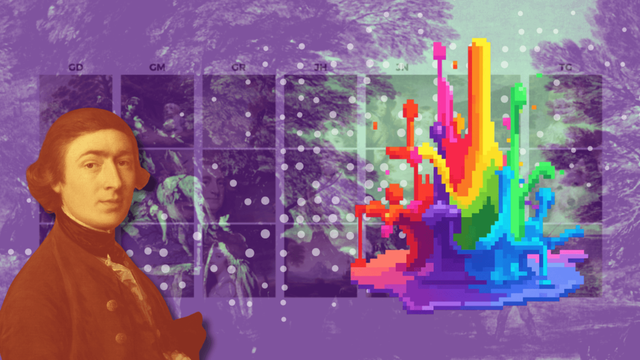
Synthetic visual data is increasingly being generated to account for the lack of available high-quality visual data that can be used to train AI models. For instance, in one study, synthetic visual media were generated using Stable Diffusion and DreamBooth to increase the representation of artwork from specific late 18th and early 19th century British painters to build an AI model for author attribution. In the process of creating synthetic visual data, existing images of British painters’ artwork were subjected to machine editing such as rotation, scaling or contrast changes, to create various variants of the original data. This image questions the fine line between synthetic media and AI slop. Some uses of synthetic media can be useful for training AI models, but they can also cause model collapse due to the poor quality of the training data.