
Part 3 – Explainable disruptions, dilemmas and directions
Here is the final part of my series of summaries of the provocative essays published in UNESCOs AI and the Future of Education The collection argues that education requires more than technical fixes. Education is social, it will take dialogue, reflection, and imagination to co-create an inclusive, ethical, and human-centred educational future. Our stories about AI and education are still being written, and we have a collective responsibility to shape them with care, clarity, and courage. Part one is here And part 2 here Page 98: Compassion by design: Building AI with and for caring educators (Arafeh Karimi) Arafeh Karimi […]
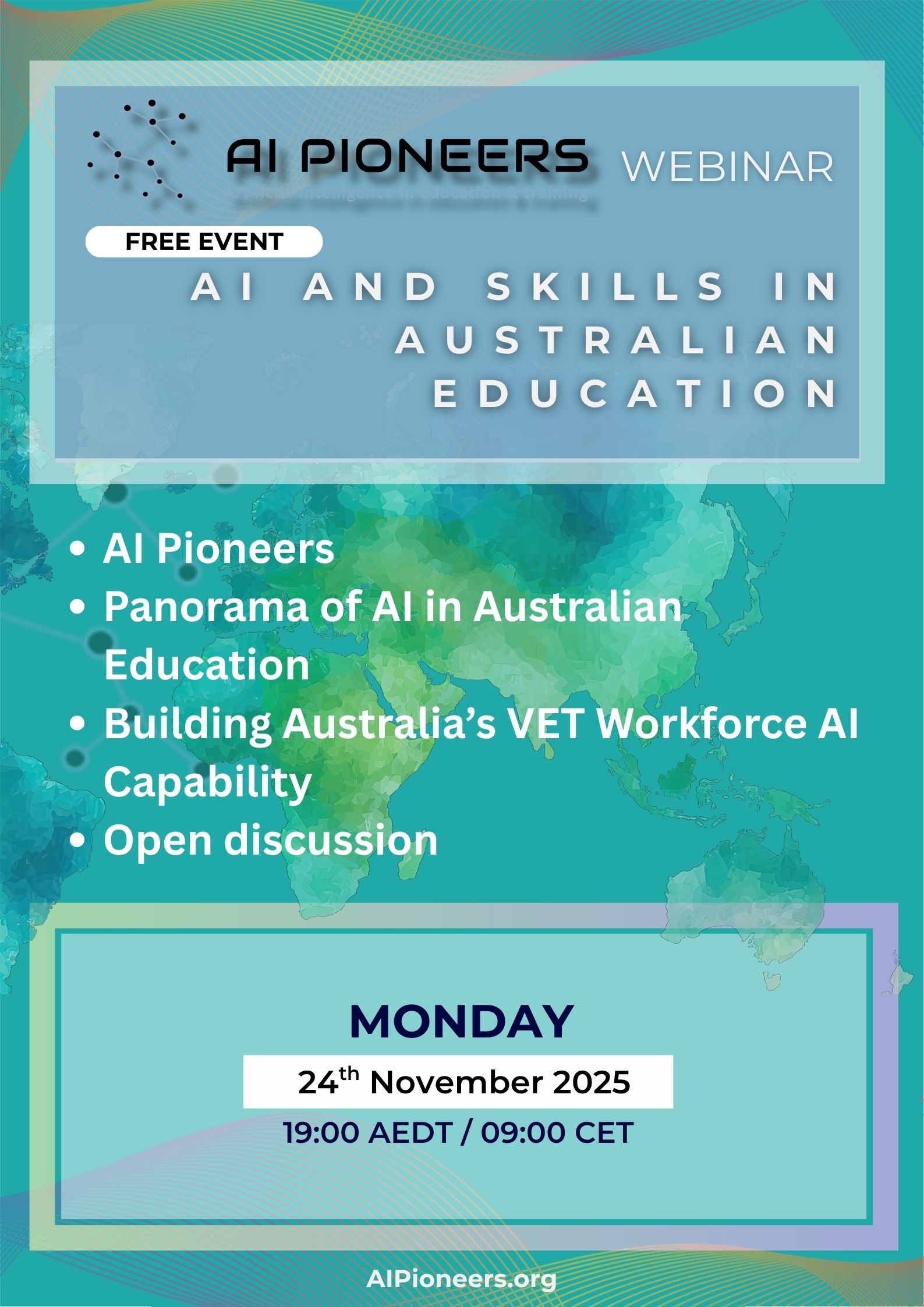
Global Insights on AI in Education & Skills: Join Our Special Webinar with Australian AI Pioneers
Here at AI Pioneers, we’re thrilled to be bridging […]
AI@School Curriculum and Resources
Before most people had heard of OpenAI, Pontydysgu coordinated an Erasmus+ schools project to engage teachers in how to teach with and how to teach about AI. It covered the fundamentals; terms, technologies, ethics, and gave practical examples for using AI in the form of a toolkit and scenarios. There’s a curriculum written in a train the trainer style and a short 10 things about AI course too. The AI@School team included a mixture of teachers, teacher trainers, academics and EdTech experts. Many of them started work on the project not knowing the first thing about Artificial Intelligence. They spent […]
Thing 9 – Supporting SEND pupils
As education professionals, we’re always looking for new tools to remove barriers and create more inclusive classrooms. In recent years Generative AI has promised to do just that, but there hasnt been a huge emphasis on the how or the why. You might have heard of tools like ChatGPT, Gemini, and Claude in the context of essay writing, but their true power for Special Educational Needs and Disabilities (SEND) lies in the potential to personalise learning at scale. Think of it your chosen GPT as a tireless teaching assistant that can instantly adapt resources to suit an individual pupil’s needs. […]
Using Machine Learning To Help Refugees Succeed
The Stanford Immigration Policy Lab has developed GeoMatch, a machine learning tool designed to optimize the placement of refugees in host countries to enhance their employment prospects. By analyzing individual refugee characteristics—such as country of origin, language skills, gender, and age—alongside the attributes of potential resettlement locations, GeoMatch predicts where refugees are most likely to find employment. Initial studies demonstrated that using GeoMatch could increase employment rates by approximately 40% in the U.S. and 75% in Switzerland. Dylan Walsh, 2023, HAI Stanford Check out the AI Cookbook inventory for more literature, resources, best practices and tools.
Explainable Disruption, Dilemmas and Directions part 2
Here is part 2 of a series of summaries of the provocative essays published in UNESCOs AI and the Future of Education Part one is here https://pontydysgu.eu/2025/10/explainable-disruptions-dilemmas-and-directions/ Page 59: Challenging hyper-personalization: Towards (re-)socializing learning (Carla Aerts) Carla Aerts cautions against AI-driven hyper-personalization, which risks isolating learners in algorithmic echo chambers and eroding the social fabric of learning and killing the social, collaborative spirit of the classroom. Instead, the author suggests using AI to help students work together better, improving conversation and teamwork rather than replacing it. Page 65: Infantilizing, echo chamber, or the dawn of a new enlightenment (Paul Prinsloo) Paul […]
Thing 1 – The Basics of AI
10 Things about AI is a MOOC written for an Erasmus+ project back in 2022. The content is still relevant, particularly the background and ideas about what AI is and how AI works. Here’s Thing 1… Artificial intelligence is now an integral part of our lives but what is it exactly? AI is not a “thing”, it isn’t a computer nor a machine. AI is the ability of a machine to display human-like capabilities such as reasoning, learning, planning and creativity. AI systems are capable of adapting their behaviour to a certain degree by analysing the effects of previous actions […]
Explainable disruptions, dilemmas and directions
I read UNESCOs AI and the Future of Education […]
Safeguarding students from AI
Watching this interview with Shafika Isaacs, Chief of Section for Technology and AI in Education at UNESCO earlier and one quote really stood out for me.
AI is fundamentally designed as an unethical ecosystem.
Which means it is imperative for …